Cross-Group CA Matching for Crypto Telegram Signals
Summary
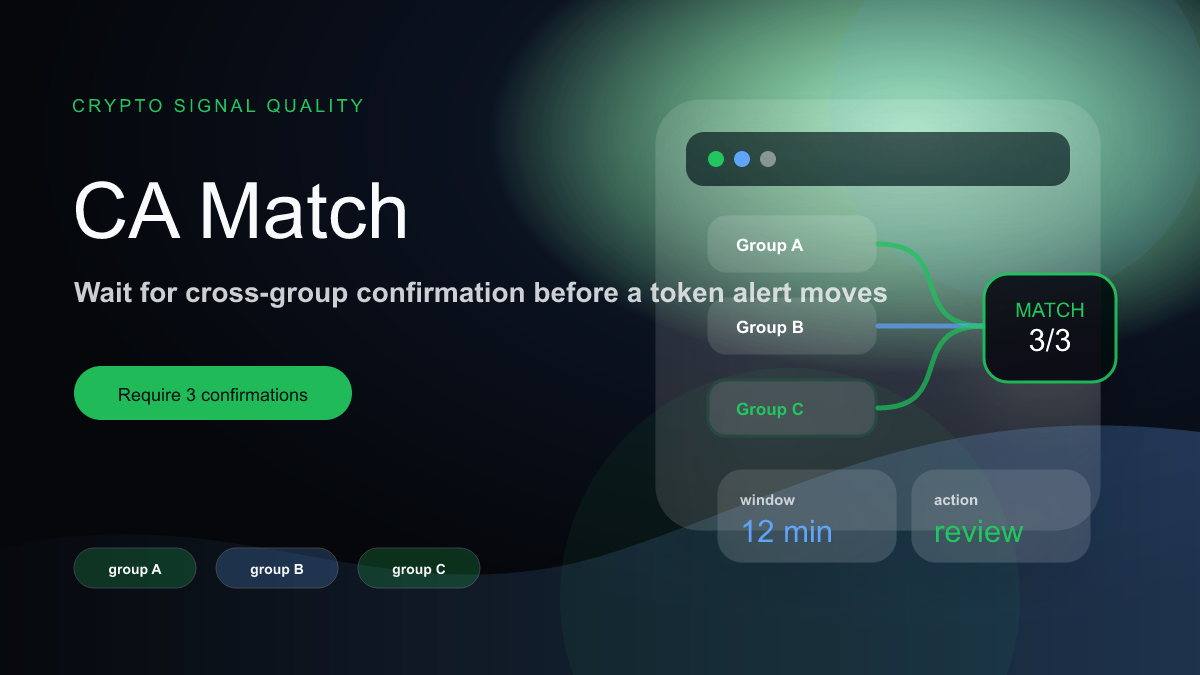
Cross-group CA matching is a quality-control workflow for crypto Telegram monitoring. Instead of forwarding every contract address as soon as it appears, the system waits until several independent groups mention the same address inside a configured time window, then routes the match to review.
This guide is based on the Telegram channel announcement from 2026-03-25 and the Cross-Group CA Matching workflow. It is written for crypto community operators and analysts who monitor many Telegram groups for contract address mentions, with a practical focus on review quality, reader trust, and repeatable operations.
The workflow connects naturally with Trading Tools and the broader automation stack on auto-bot.io. For teams building a larger Telegram operating system, pair it with Telegram Forward so collection, filtering, and review do not live in separate manual steps.
Why This Workflow Matters
Crypto Telegram groups often produce repeated tickers, partial contract addresses, copied calls, and emotional commentary. Forwarding every mention can overwhelm analysts and make a channel look noisy. Matching does not prove that a token is safe or valuable, but it can reduce low-context alerts and make review queues easier to manage.
This is not financial advice and it should not be treated as a trading signal by itself. The workflow is an information-routing pattern. It helps an operator decide what deserves review, source checking, and risk analysis before anything is published to a community.
Good automation should make the next human action clearer. It should not hide uncertainty, inflate a weak source, or turn a messy message into a polished claim without context. That is why the best setup includes source labels, timestamps, routing rules, and a review habit that the team can inspect later.
For Google and LLM discovery, this also matters because useful content answers the operational question behind the keyword. A reader searching for cross group CA matching crypto Telegram probably does not need a vague feature list. They need a concrete workflow, examples of when to use it, and a safe boundary around what automation can and cannot decide.
Recommended Workflow
Use the workflow below as a starting point. The exact settings will depend on your source quality, destination audience, and tolerance for manual review, but the sequence keeps the operation understandable.
- Normalize contract addresses: Extract candidate addresses and standardize formatting so the same CA can be compared across groups.
- Choose independent source groups: Avoid counting mirrored groups as separate confirmations because copied messages can create false confidence.
- Set a time window: Use a short enough window to capture momentum and a long enough window to avoid missing slower discussions.
- Require a threshold: Hold alerts until the configured number of groups mention the same CA.
- Route to review: Send matched addresses to a review channel with source links, timestamps, and notes rather than public-posting automatically.
The most common mistake is adding automation at the final forwarding step only. That makes the system faster but not necessarily better. A stronger setup improves input selection, cleaning, review context, and the final destination rule together.
Comparison Table
| Option | Operational Value | Best Use |
|---|---|---|
| Single mention | Fast but noisy | Useful only for low-stakes watchlists |
| Two-group match | Reduces obvious noise | Good for early internal review |
| Three-group match | Stronger operational filter | Good default for public channel prep |
| Manual analyst approval | Adds judgment and context | Required before sensitive publishing |
This comparison is intentionally operational rather than promotional. The right answer is not always maximum automation. For high-impact messages, a slower path with better review context can produce a better reader experience and fewer corrections later.
Implementation Details
Start with a private test route before changing a production channel. Choose one source, one internal destination, and one reviewer. Run the workflow for several cycles, then compare the output with the original Telegram messages. The review should ask whether important context was preserved, whether noise was reduced, and whether the next action is obvious.
Use naming conventions for routes and filters. A rule named crypto_filter_01 is harder to review than a rule named ca_match_three_groups_12min. Clear naming makes it easier for another operator to understand what will happen when a message arrives.
Also separate collection, transformation, and publishing. Collection decides what enters the system. Transformation decides how it is cleaned or summarized. Publishing decides where it goes. Keeping these layers separate makes debugging much easier when an output looks wrong.
Finally, keep screenshots or sample outputs from the test run. A short example is often more useful than a long settings document because it shows exactly how the workflow behaves with real input. That evidence helps future operators maintain the system instead of guessing why it was configured a certain way.
Checklist
Before moving the workflow into production, review this checklist.
- Mirrored groups are excluded.
- Threshold is documented.
- Time window is visible.
- Review channel includes source context.
- No post implies profit, safety, or endorsement.
If any item is missing, keep the route private until the gap is fixed. Publishing faster is rarely worth the cost of confusing readers or sending a message that lacks source context.
Where Auto-Bot Fits
Auto-bot.io products are designed for operators who need practical routing, filtering, and review workflows rather than one-off scripts. Use Trading Tools as the primary product path for this workflow, then connect related source or browser automation only when the use case requires it.
If your team is still mapping the full Telegram stack, read Telegram Automation Playbook for 2026. It explains how source capture, filters, media handling, buttons, and review policies fit together across a complete automation pipeline.
FAQ
Does CA matching prove a token is good?
No. It only shows that the same contract address appeared across selected sources. Human review and independent research remain necessary.
Should matched alerts post publicly by default?
For most teams, no. A review queue is safer because crypto content can move quickly and mistakes can create user harm.
What should teams measure after launch?
Track how many messages were collected, filtered, reviewed, corrected, and finally published. That data shows whether the workflow is improving attention quality or simply moving noise to a new place.
Level Up Your Trading
Expert advisors and indicators for MT4/MT5 — built by a verified MQL5 seller.
Verified seller • 5-star rated