A Better Playbook for Keeping Discord and Telegram in Sync
Summary
Community sync is not just about copying messages between platforms. It is about preserving enough meaning that Telegram members can follow the same momentum as Discord members.
The official docs position Discord to Telegram for communities across news, events, support, gaming, and trading. That makes “community sync” a broader problem than simply forwarding messages. The real challenge is keeping the destination useful enough that Telegram members feel connected to the same momentum.
Community Sync Is Not Just Copy-Paste
Communities behave differently on each platform. Discord rewards active, layered discussion. Telegram often rewards cleaner, faster consumption. A strong sync playbook respects those differences while still preserving the substance of the update.
That means operators should decide which channels deserve full continuity, which ones deserve filtered highlights, and which ones should stay native to their original platform. Without that decision, “sync” quickly turns into noise.
A Better Playbook for Operators
- Choose the channels that shape community momentum: Announcements, support, events, and paid-value channels usually matter most.
- Set different expectations per route: Some routes should preserve context; others should focus on clean signal delivery.
- Review Telegram as its own audience: Ask whether the destination feels coherent without requiring Discord knowledge.
- Use one owner per route: Someone should be accountable for whether the sync still makes sense.
- Refresh the playbook when the bridge changes: Release-driven features like clone mode should update how you operate the route.
Why This Angle Converts Better Than Generic Automation Copy
Readers interested in cross-platform community sync are not searching for abstract claims about efficiency. They want to know whether the product can help them keep two communities aligned without doubling moderation pain. That is why a playbook article performs better when it speaks in platform-specific terms.
It also makes the CTA obvious. If the need is Discord-origin community sync into Telegram, the correct next step is Discord to Telegram, not a Telegram-native forwarding tool.
Where Teams Usually Get It Wrong
The most common mistake is forwarding everything because “more sync” feels safer. In practice, that often weakens both platforms. Discord becomes messy because nobody curates what really matters, and Telegram becomes noisy because too much discussion lands there without context.
The better approach is route-by-route thinking. Identify the conversations, announcements, and assets that actually carry community value, then bridge those with care.
What Good Community Sync Feels Like
Good sync feels like continuity, not duplication. Telegram members should feel informed and included, while Discord members should still feel their platform has its own native value. The bridge succeeds when both communities gain clarity instead of both communities inheriting the same noise.
That is the operational standard worth teaching. It is much stronger than generic claims about automation efficiency.
Why Route Ownership Matters
Community sync degrades quickly when no one owns the quality of the route. Someone should be responsible for checking whether the bridge still reflects what the community actually needs, especially after new features or behavior changes are introduced. Without that owner, bad sync becomes normal noise.
Operator Notes
A simple route review cadence helps a lot here. Even a short weekly check on top routes can reveal whether sync is still serving the community or has drifted into noise. This is one of those workflows where consistency beats complexity.
It also gives the team a cleaner basis for deciding whether a route should stay mirrored, be filtered, or be retired altogether. Good community sync is maintained, not assumed.
Teams that do this well often keep a tiny route charter for each bridge: purpose, audience, owner, and the reason that route deserves to exist. That document sounds simple, but it prevents a lot of avoidable sprawl.
Once those basics are written down, future release changes are much easier to evaluate against the route's original purpose.
That clarity is what keeps a sync playbook useful months later, when nobody clearly remembers why a route was created in the first place.
It also makes onboarding new moderators easier, because they can understand the logic of the bridge instead of inheriting a pile of unexplained settings.
In practice, this is how a community sync route stays intentional rather than turning into a background process that nobody actively questions anymore.
That intentionality matters because platform needs change. A route that once served the community well may later need tighter filtering, different owners, or a different cadence. A playbook gives teams a way to make those adjustments deliberately instead of reactively.
Community Sync Checklist
- The route has a clear purpose, not just a vague “sync everything” goal.
- Operators know which channels deserve full continuity.
- Telegram readers can understand the output without confusion.
- Someone owns the route and reviews it regularly.
- The CTA still points to the bridge product that solves this exact problem.
Comparison Table
| Sync strategy | Healthy version | Weak version |
|---|---|---|
| Route selection | Selective and purposeful | Everything is forwarded by default |
| Reader experience | Telegram gets coherent updates | Telegram gets context-poor overflow |
| Ownership | Each route has a reviewer | No one is accountable |
| CTA | Point to Discord to Telegram | Send users to the wrong product |
Build a Cleaner Sync Strategy
If your goal is real community sync, start with Discord to Telegram, then test only the routes that carry genuine community value. For the release-level feature that strengthens context preservation, see Discord to Telegram v1.0.5: Clone Message Mode.
FAQ
Should every community use full mirroring?
No. Some communities benefit more from selective sync than from exact continuity.
What is the first review question?
Ask whether a Telegram reader can follow the route without already living inside Discord.
Why write this as a playbook?
Because community sync is an operating problem, not just a feature checkbox.
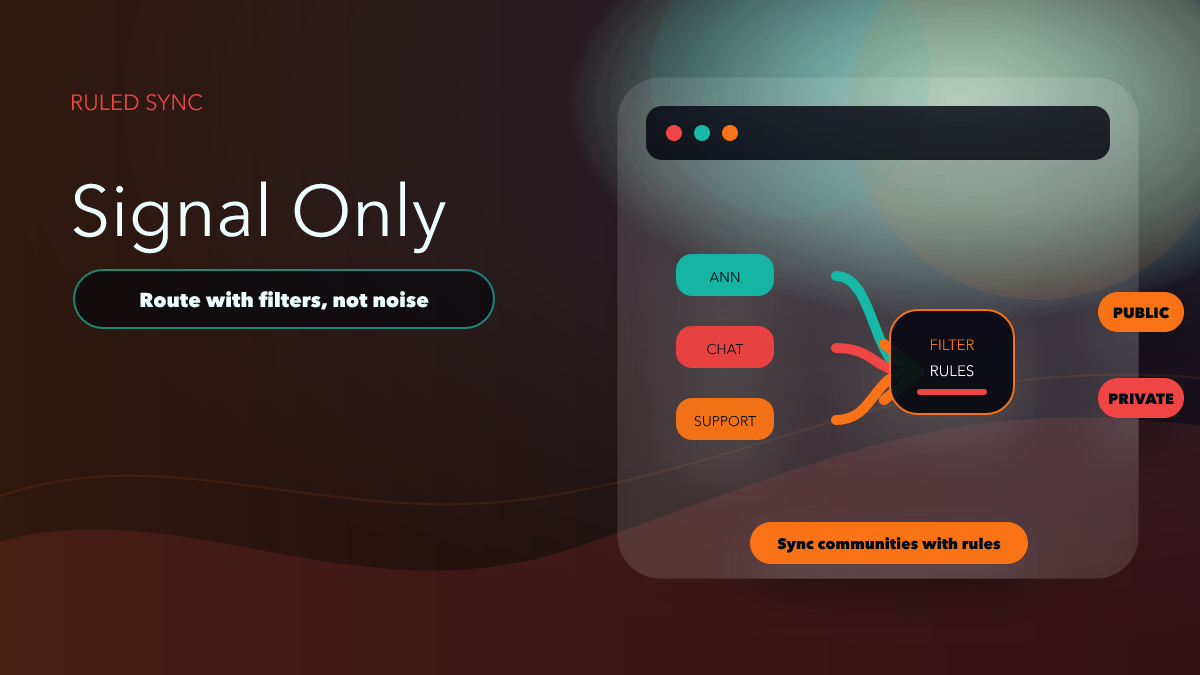
Sync Communities With Rules, Not Noise
Use the bridge with filters and routing rules when different Telegram destinations need different slices of Discord activity.
Works best with destination-specific filters