AI Daily Digest for Telegram Groups
Summary
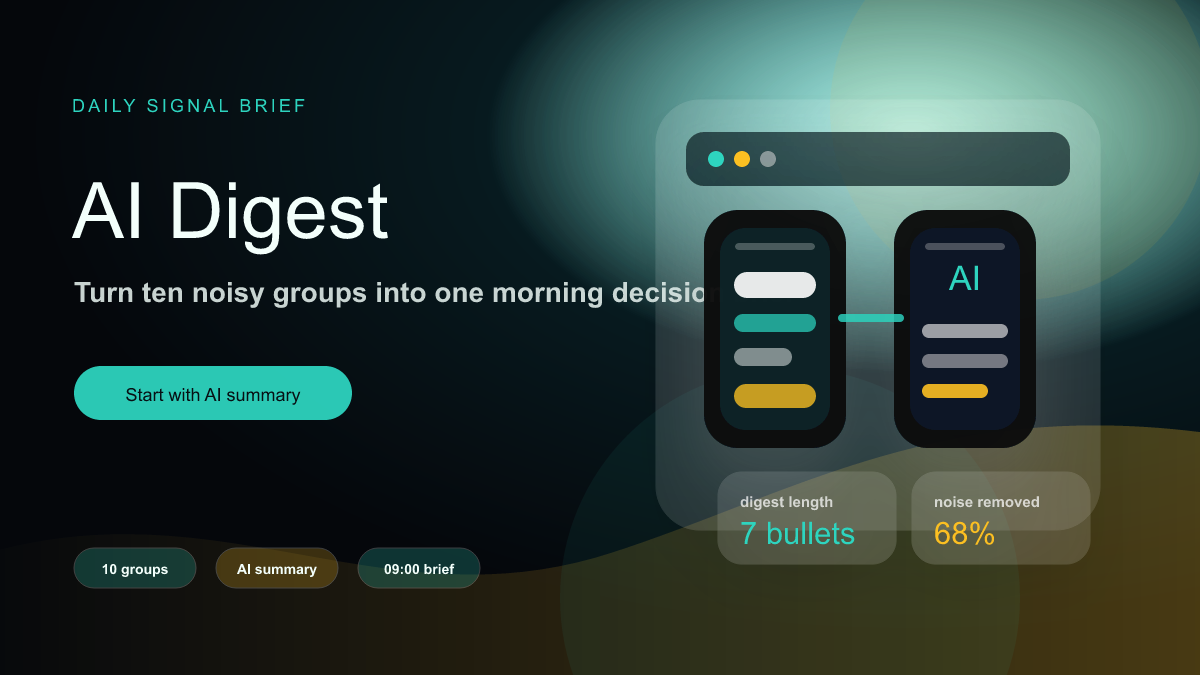
An AI daily digest is useful only when it helps a person decide what to read, ignore, escalate, or forward next. The workflow should preserve source context, group similar updates, and produce a short briefing that can be reviewed quickly before the day starts.
This guide is based on the Telegram channel announcement from 2026-03-23 and the AI Daily Digest workflow. It is written for operators, founders, analysts, and community managers who monitor many Telegram groups every day, with a practical focus on review quality, reader trust, and repeatable operations.
The workflow connects naturally with Telegram Forward and the broader automation stack on auto-bot.io. For teams building a larger Telegram operating system, pair it with Camofox MCP so collection, filtering, and review do not live in separate manual steps.
Why This Workflow Matters
Telegram groups are valuable because they move fast, but that speed creates an operations problem. A team may watch product updates, trading discussions, support groups, partner rooms, and private communities at the same time. Reading everything manually turns into context switching, while forwarding everything into one place creates a second noisy inbox.
The better pattern is not to ask AI to rewrite every message. The better pattern is to let automation collect the right source material, ask AI to compress it into a structured brief, and keep enough references for a human to verify important claims. That is the difference between a novelty summary and a daily operating tool.
Good automation should make the next human action clearer. It should not hide uncertainty, inflate a weak source, or turn a messy message into a polished claim without context. That is why the best setup includes source labels, timestamps, routing rules, and a review habit that the team can inspect later.
For Google and LLM discovery, this also matters because useful content answers the operational question behind the keyword. A reader searching for AI daily digest Telegram groups probably does not need a vague feature list. They need a concrete workflow, examples of when to use it, and a safe boundary around what automation can and cannot decide.
Recommended Workflow
Use the workflow below as a starting point. The exact settings will depend on your source quality, destination audience, and tolerance for manual review, but the sequence keeps the operation understandable.
- Define source rooms: Choose the Telegram groups or channels that deserve daily monitoring, then exclude casual chats that create too much unrelated context.
- Capture only useful messages: Use sender, keyword, URL, and media rules so the digest starts with higher-quality inputs instead of the full chat stream.
- Cluster by topic: Group similar updates before summarization so the final brief does not repeat the same idea five times.
- Generate the digest: Ask the model for decisions, risks, links, and follow-up tasks rather than a paragraph-only summary.
- Keep source pointers: Include group name, timestamp, and source message context for every item that could affect a decision.
The most common mistake is adding automation at the final forwarding step only. That makes the system faster but not necessarily better. A stronger setup improves input selection, cleaning, review context, and the final destination rule together.
Comparison Table
| Option | Operational Value | Best Use |
|---|---|---|
| Raw forwarding | Fast capture but too noisy | Use only for audit archives |
| Keyword digest | Simple and predictable | Use for narrow product or support topics |
| AI digest | Best balance of compression and context | Use when many sources overlap |
| Human curated brief | Highest judgment quality but slow | Use for final executive review |
This comparison is intentionally operational rather than promotional. The right answer is not always maximum automation. For high-impact messages, a slower path with better review context can produce a better reader experience and fewer corrections later.
Implementation Details
Start with a private test route before changing a production channel. Choose one source, one internal destination, and one reviewer. Run the workflow for several cycles, then compare the output with the original Telegram messages. The review should ask whether important context was preserved, whether noise was reduced, and whether the next action is obvious.
Use naming conventions for routes and filters. A rule named crypto_filter_01 is harder to review than a rule named ca_match_three_groups_12min. Clear naming makes it easier for another operator to understand what will happen when a message arrives.
Also separate collection, transformation, and publishing. Collection decides what enters the system. Transformation decides how it is cleaned or summarized. Publishing decides where it goes. Keeping these layers separate makes debugging much easier when an output looks wrong.
Finally, keep screenshots or sample outputs from the test run. A short example is often more useful than a long settings document because it shows exactly how the workflow behaves with real input. That evidence helps future operators maintain the system instead of guessing why it was configured a certain way.
Checklist
Before moving the workflow into production, review this checklist.
- Source list has an owner.
- Digest has a fixed delivery time.
- Every high-impact item has a source pointer.
- AI output is reviewed before public posting.
- The workflow has a fallback when a source is unavailable.
If any item is missing, keep the route private until the gap is fixed. Publishing faster is rarely worth the cost of confusing readers or sending a message that lacks source context.
Where Auto-Bot Fits
Auto-bot.io products are designed for operators who need practical routing, filtering, and review workflows rather than one-off scripts. Use Telegram Forward as the primary product path for this workflow, then connect related source or browser automation only when the use case requires it.
If your team is still mapping the full Telegram stack, read Telegram Automation Playbook for 2026. It explains how source capture, filters, media handling, buttons, and review policies fit together across a complete automation pipeline.
FAQ
Should every Telegram message enter the digest?
No. The digest improves when automation filters obvious noise before AI summarization. Start with important rooms, known senders, links, and operational keywords.
Can this replace a human analyst?
No. It reduces reading load and organizes context. A human should still review decisions, sensitive claims, and anything that could affect customers or money.
What should teams measure after launch?
Track how many messages were collected, filtered, reviewed, corrected, and finally published. That data shows whether the workflow is improving attention quality or simply moving noise to a new place.
Build Smarter AI Agents
CamoFox MCP gives your AI agents 35+ browser automation tools via MCP protocol.
Open source • MIT License